

That’s very much who I am – so that’s where I’ll start.
There are many roles you can assume in concept art, some of them are incredibly specific.
You usually find those kinds of highly specialized roles in AAA games, animation or in the movie industry.
When you work in smaller or medium-sized teams, the term “Concept Artist” can sometimes “absorb” a number of others. Other contracts may offer a similar variant under a “2D Game Artist” position.
Why is that? Usually because the budget doesn’t allow for having more than one Concept Artist on board. Not in a full time, permanent capacity at least.
Well, it really depends on the scenario and the needs of the project itself.
So, if:
- You land a position as a “Concept Artist”, “2D Game Artist”
- The team is small (or the scope of the project is)
the most common occurrence is that you will be responsible for the development of characters, environments and props. If we’re looking at a 2D artist most probably UI and illustrations as well.
More on this later.
In this article, I’ll break down what being a generalist concept artist really means in practice.
Let’s have a quick overview:
CHARACTERS
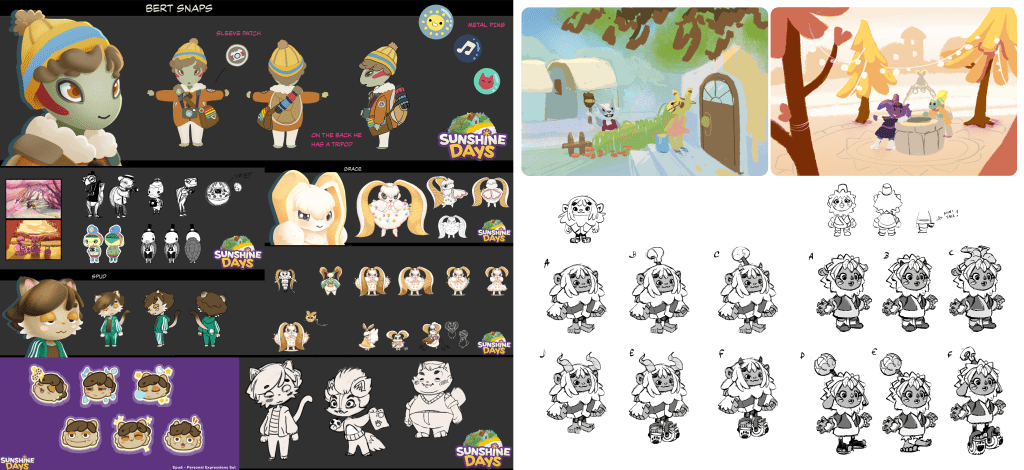
I worked on some of the characters for the first game incarnation – at present you can play the second chapter, which is a town builder)
The Character Design role is the one most artists would like to pursue as a career, especially in the beginning.
Yet, it is also one of the most difficult position to obtain, especially as a first job and particularly in Game Development.
Reasons are a simple matter of numbers:
- In any given projects you will always have more tasks related to props and environment development, than characters.
Even when you have a lot of characters, this proportion will stay the same.
Usually, there is no need for more than one or very few character artists per project at a time. - Sometimes – Most of the times, actually – the amount of characters in a project is not enough to justify hiring someone in a permanents role for this task.
So you (as a company) either task a generalist or hire a freelancer. - There are many skilled freelance Character artist already on the market – with many years of experience, so the competition is always very tight.
This doesn’t exclude newcomers, tho – It simply changes how you approach the market.
Companies are always looking for fresh hands.
It means you need to raise your skills at a similar level of some of the competition.
Which, as we all know, takes time and focused effort.
All this considered then – unless you:
– Are hired to work on a project involving a lot of character development for an extended period of time – Or for a company with a constant flux of projects involving character development
It can be difficult to land a permanent position solely as a character designer.
I’m not saying impossible. If you are ready and consistently look around, the right opportunity may come your way. It also requires consistency and strategic effort.
But I think it’s important to be aware of how rare and sought-after these positions are.
If it’s the only thing you want to do, you’d better prepare to give it your 200%.
You need to excel at your craft, plus relentlessly work on presenting your work, your process. Plus, submitting to every opportunity that can help you move a step further in the right direction.
It is a different story if you are starting as a generalist concept artist.
In that case, among other roles, you can ALSO cover the character designer one.
That means, naturally, working also on environment and props design.
[On a side note: you totally can also try to work as a specialist in props and environments too. That is a market way less crowded than character design.]
WHAT ABOUT DESIGNING FOR ANIMATION?
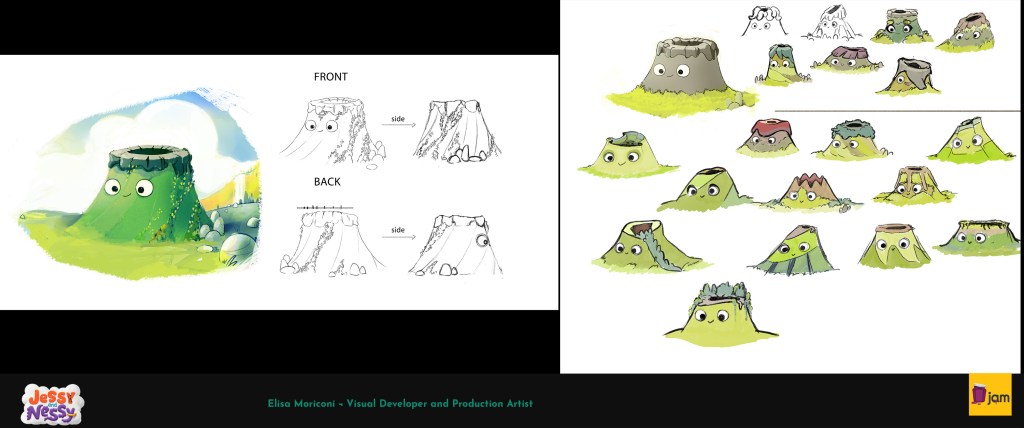
Just a different example of how disciplines sometimes cross each other.
When it comes to the Animation world, things are a little bit different.
Animation art teams are much more structured than the average GameDev company, with more specialized roles.
So, if you’re a Character Designer for Animation, chances are that is what you’re gonna do.
Which is a good news for those artists who enjoy a clearly defined role.
But what about those among you who like variety and don’t feel comfortable with a single repeatable task?

You could look up the position of:
- Visual Developer or
- Production Artist (more to come about these in a future article).
These roles are different from the Generalist Concept Artist one in videogames.
You will probably still have some opportunities to work on those 3 “macro-categories” but in different ways.
In Games, a Concept Artist work on their assignment from its early design to the conclusion.
In Animation the mood and general design and the exploration are done by the Visual Developers.
The Character Design is done by the Character Designer.
And then you have Production Artists, Layout and Background Artists and Color Artists, etc.
Each of them is set to work in a specific point of the pipeline.
As always, this aspect can be flexible, depending on:
- The skillset of the person
- The size of the studio
- The needs of the project
Since this will require a long, separate explanation, I’ll just briefly run through it:
- Visual Developers: They touch a bit of everything in the earlier development stage. Consider them as explorers. They explore styles, mood, colors, and shapes. What they do could be substantially different from the final product (movie, tv series).
- Character Designers: Once the story and world building have been set, character designers well… Design the characters. Their work involves design as well (as per their name).
- Once all explorations are done, the Art Director decides on the final stylistic appearance of the show. Together with its Lead Artist/s they set the foundation and examples for the whole team to follow.
- Production Artists: They fall in the middle of visual development and final development. They create everything that help create the next stage:
- Callout sheet
- Write down instructions
- Makes a design possible to be built
- Work – sometimes – with color
- Turnarounds (a lot of turnarounds)
- And sometimes they need to know a bit of math too. Not everyone’s favourite…I still remember the day when I first had to face it! But I managed. A story for another time!
ENVIRONMENTS
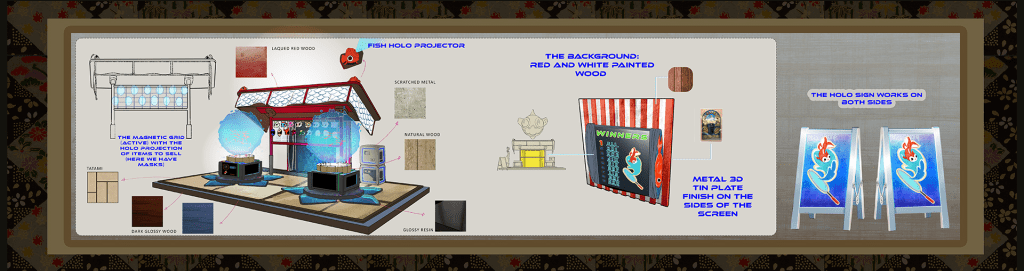
Environment design is strictly related to props design too.
An environment is alive, and what makes it alive are the assets in it, the textures, the colors and materials… Every bit that give is story and personality.
Each one of those bits needs careful development.
The more central to the story it is, the more you care – but even a basket in a corner of a house has its dressing purpose.
Let’s get back to our career of a generalist concept artist.
As I said, we will work on a bit of everything, therefore on environments too.
What does it mean to work on an environment?
Well, really, it has to do with building everything involving the space you as a player will move in (plus with your character, of course).
What sometimes happens is that people are massively fascinated by landscape (artists love nature) but they don’t consider they will have to work on loads of interiors as well.
So my advice is, when you’re looking for a new job and you’re working on your portfolio, always consider the “worst case scenario”.
If you’re applying for a job focused on environments you want at least the style to be one you love.
Take some time to review your portfolio with this in mind.
Don’t just ask yourself what you can do – ask yourself what you’d still enjoy doing on a difficult day.
Because, even if you have a specific preference (let’s say you like trees and natural environments), if they ask you to draw the interior of a fish hut, chances are you’ll be much happier to do it in a style that gives you joy, that in one you applied to “because you could make it work”.
Don’t do this to yourself.
I mean, this is valid for each focus you may have. Be those characters (is not just pretty faces or only boys /girls /ogres / young or old people…. you may have preferences still, you will have to do everything) or props.
Also remember you have a variety of tools at hands that can makes easy familiarize with concepts that is not possible to avoid, like the most feared of them all… Perspective.
Nope, you can’t avoid it. You need to make things work.
So, for those who needs to improve on them you can use 3D software (I mean, Blender is even free and it’s AMAZING) or 2D software with great plugins for perspective (like Clip sTudio Paint which, by the way, also has 3D tools integrated).
Because you’ll have a tool to help ou with perspective while learning about 3D and Grease pencil, one of the most interesting tools developed for Blender for 2D artists in my opinion!
Another artist I was chatting some time ago made the most beautiful sketches over existing pictures, just to help his brain familiarize with the depth and complexities of perspective in an organic, and “safe” way.
Just by sketching over it, your brain learn in time how perspective works in a natural way.
Sometimes we’re swept so much into learning the technical side of things that we forget to play with our art.
Playing with it is what engages us and allows us to improve.
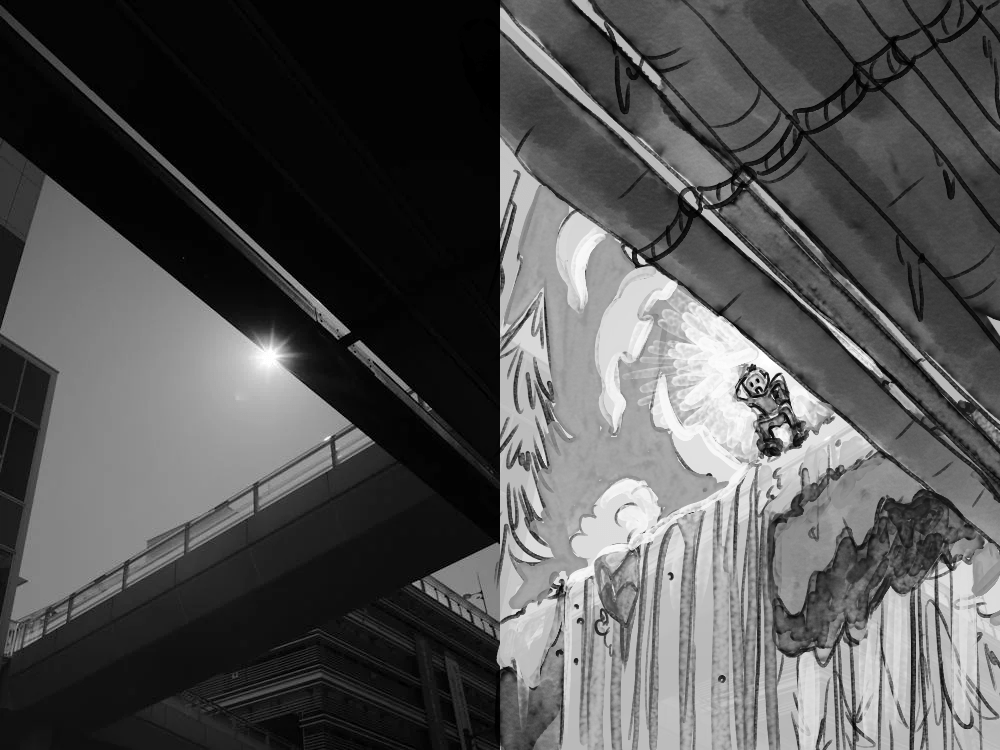
The goal isn’t realism… It’s exploration!
The important thing is that it will unblock in you the resistance towards different camera points of view.
By making a lot of cute silly doodle like this, you’ll start to get into using perspective much quicker than you could have ever thought.
Original Picture: https://www.pexels.com/@mak_-jp-107017486/
Exactly as it is the case for characters, environments as well have their own story and personality. A room is not just a room. Who uses it? What’s its purpose? Is it a private space, a corporate one, a secret hide? Is it new or has it a past? What kind of materials were used there and why? Was it subject to renovation, partially or totally? In which historic era was it built? And what year is the one where it lives right now?
Depending on the project there is another skill useful to have when you work on environments. I briefly mentioned it before and it is the conscious use of camera lens and point of view. It helps you telling your story, highlighting specific assets or moments and it accompanies the player (or the viewer, if you’re working on movie or animations) along its journey.
To this end, it’s good to take a look at photography and cinematography books. This will help you getting a good idea of the possibilities lying in front of you.
3D softwares also have their own camera system built in and you can learn from that as well. This is particularly useful when you want to convey to your colleagues the specific scene you’re trying to create.
The right use of focal lenses and cinematography is another language you’ll want to learn and build over in time. Exactly as you are doing with design and shapes and colors and light. Every creative language makes your work richer. The more you know about it, and the more effective your communication will be.
An environment speaks to you, if you build it correctly. It tells a story. It gives us the information we need, without the need to overly explain it. It gives us the right mood, let us enter the story and immerse ourselves in it.
To do that, of course, environments also need props. It’s safe to say that sometimes, also props need props… But that’s for later.
PROPS
I know you expecting this by now… And you’re right!
Props are the same – in a sense – as characters and environments.
They have their own personality, they represent a part of a story and their design can help to give character to a scene, or to maintain a coherent shape language. They can have “sub props” of their own or work for another categry (being related to a character or an environment.
Sometimes they’re just part of a collection of objects! It happens a lot with season passes and every kind of collectible item in games. In that case, it has to:
- Maintain the style of the game
- Show clearly the connection and the theme that the collection is meant to share and represent
- Remember, those items are 90% meant to be mixed and matched with other items from other collections inside the game.
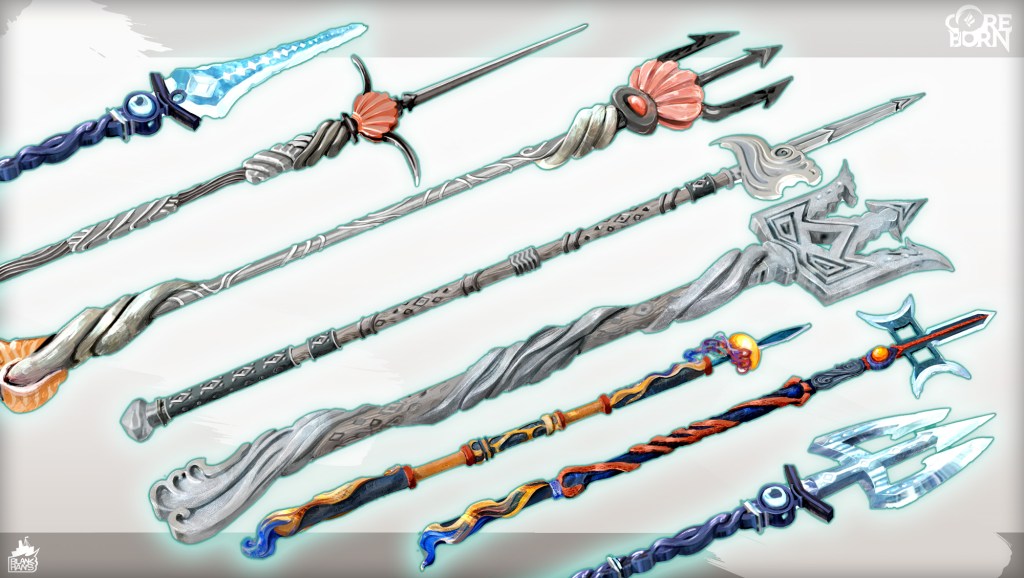
The overall theme was “aquatic world” and, for each region of that world, there were A spear and a trident. We also considered swords in this set, but it was decided to not adopt swords in this area of the world as they are distinctive to the original one.
A common problem about working with props is the tendency artists have, especially in the beginning, of trasforming everything into an hero asset.
What do I mean with this?
A hero asset is something meant to shine, to be important. Is the one you want to collect, the one you need to grab, the pretty, or majestic, or attention grabbing. It is meant to shine.
On the other hand, there are tons of props meant to be… plain. You need them to make the scene alive and realistic. And you mean them to make the hero assets truly be desirable and attractive. After all, if everything is important, nothing really is…

…AND EVERYTHING ELSE IN BETWEEN
If you’re a generalist, chances are you’re gonna work on many different things. In my time at Netspeak Games as a concept artist – for example – I worked as well on icons, banners, avatars, or illustrations for the marketing team, covering a wide range of additional 2D responsibilities.
You may need to work on storyboard, keyframes or logo design as well! Maps… You’re the 2D artists so every 2D task will come knocking at your door, especially if you’re in a small team: be prepared (and, hopefully, excited).
And when you work with illustration you need to think about design in a different way and to polish your work (it is very rare to see a pictorial UI).
So… once again, versatility is key!

WRAPPING IT UP
If you’re a generalist artist, especially in game, you’re going to be able to engage in different tasks. This allows you to keep your interest alive, especially if you’re an ADHDer like myself who needs to explore new things as often as possible.
You will need to be patient because, as we explored above, having to cover the entire spectrum of the 2D profession means you need to gather and nurture a really wide variety of skills.
All of the fundamentals are the basics for each artistic profession, but you’ll have to be more flexible and learn more tools than if you had a single focus.
On top of that, it will take you more time to get to the same professional level of other artists with a single (or more focused) interest because… The time allocated is the same for everyone and the more you spread yourself thin, the less hours you have to improve, that’s just math.
But you can if you make a plan for yourself.
Some people are lucky and receive support while they study and take their first steps.
Other people need to find first themselves a job first, while they hone their art skills.
The only thing that counts is: eye on the prize and know what you want!
What kind of job would make you happy? Something specific or would you like to be the generalist 2D person we were talking about? What’s the style and what are the stories that your heart resonates with? What kind of career would you like to build for yourself?
And I’ll be practical here: how much money do you need? Because you need to know in order to plan for a job. Not every position will give you what you want in terms of salary, holidays, time at home, quality of the projects or variety of them.
That’s what I mean when I say: plan ahead.
And remember, you can always change in the future. Things rarely stay the same forever and you don’t have to be stuck in a situation you’ve outgrown.
So don’t give yourself a “life goal”, give yourself a reasonable goal in line with what you want and what you need now. You will adjust the course in due time.
Do you have any other advice you wish you knew when you started and want to share here in the messages? Please leave a comment then, it’s great to grow together and to learn from each other’s experiences!
If you are new to the blog, you may be interested in these other articles written with 2D artists in mind. Both of them contain useful links at the bottom of the page!
- CAREERS FOR 2D ARTISTS – https://bethatartist.com/2025/01/16/careers-for-2d-artists-what-do-they-do-opportunities-overview/
- THE JOB OF LOOKING FOR AN ART JOB – https://bethatartist.com/2024/12/07/the-job-of-looking-for-an-art-job/
- CONCEPT ARTIST CAREER PROGRESSION FRAMEWORK https://bethatartist.com/2025/05/10/concept-artist-career-progression-framework/


Leave a Reply