


As artists we basically have two main struggles.
When we can’t understand what’s wrong
When we can only see what is wrong.
SO… Why is that?
Let’s take a moment to see how our brain works.
I think, as artists, we have a skill which is a blessing but also a source of never ending frustration. That is none other than our imagination.
When we’re children and we start drawing, we copy what is around us, what we know. But we copy everything, not just reality, but symbols as well. We’re like sponges, and we find the simpler path to represent what we want to put down on paper.
We take inspirations from what our parents and teachers draw. We copy from our comics, children books. From our school text books.
It’s rare to find a child who actually really observe and reproduce reality and that lies in many factors. Mostly, in the way we’re introduced to art. Then we see other children do the same and we just take for granted that is how you do things.
From this approach to symbolism we inherit the habit of describing the form with lines. I’m not talking about creating a shadow with several lines. I intend only giving importance to the line as a “box” containing what we’re interested in. For example a face.
When I was in middle school I had a great art teacher who explained this to us for the first time. His name is Luigi Modesti and I think he’s been a fundamental part of my art education. The reason why my passion for drawing met new inspiration and transformed itself. He made us study art seriously, even if we were just children. I will always appreciate him for it.
What did he made us do?
Among other lessons, one day he brought us a series of photographic portraits taken from magazines.
He gave us pencils and ask us to reproduce the face we chose.
The result was more or less like this (I’m using a drawing of an ex student of mine who was around 13 years old at the time, so in line with this story).
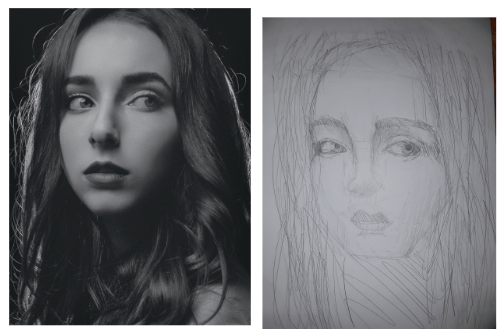
Then, he asked us to grab another portrait. I will still use this one for the sake of explanation, but it is more effective if you start working on a different subject. That is because your brain still haven’t analyzed it and formed prejudices. He asked us to put it upside down.

Yup. Like this. And at this point he told us to use our pencils to do another portrait. This time we didn’t have to draw the face. We only had to draw the shadow areas on the page. Using the negative space (at the time, a foreign concept) and spacial relationships between shadow shapes to orient ourselves.
This time the result was something more or less like this:
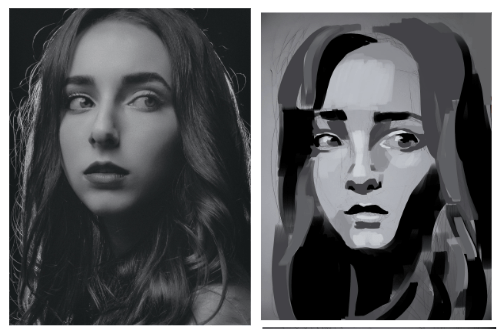
Even if it wasn’t perfect, it felt immediately more alive and three-dimensional.
This is how we learned about depth, values and about how we carry prejudices when we look at our drawings.
Because none of us could see what was wrong in simply drawing with lines. Some of us were pretty proud of what we did the first time around. Until we completed the second picture and we were completely mind blown.
THE FRUSTRATION OF NOT MASTERING WHAT WE JUST LEARNED
When you study something new, your mind is projected forward. You receive explanations about why some actions produce certain results. You understand them. Then you try to apply those new pieces of information to your art.
Your mind knows where it wants to go.
Unfortunately, your hand still doesn’t know the path.
So it lands you where you usually are, more or less. Sometimes even further behind.
Isn’t that upsetting? Yes it is.
We know what we want. We know how to do it. Yet we cannot actually do it.
Why does this happens?
Because our knowledge is experiencing a gap.
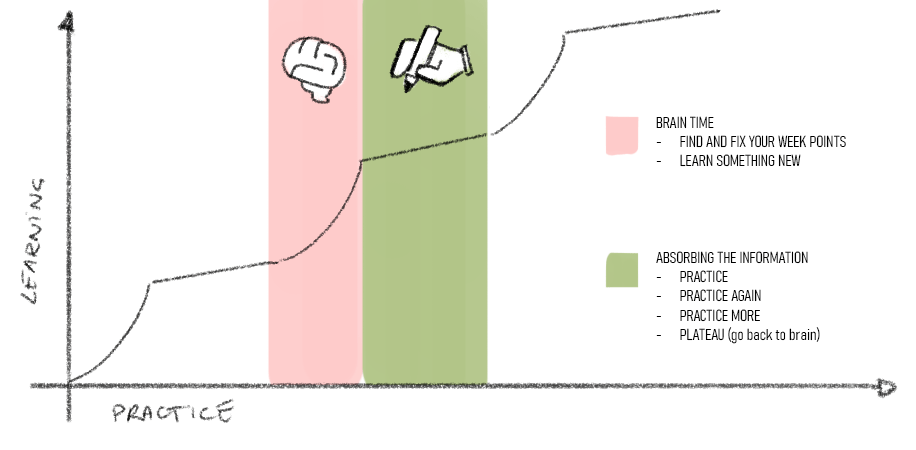
When we study something we are under the impression we already learned that. Unfortunately most of the times it is not the truth. We need to:
- Put the knew knowledge in practice
- It will probably be not satisfying. What was difficult? Analyze it.
- When you realize what you are finding challenging you can:
- Re study the topic or studying it from a new, fresh perspective
- Follow proposed exercises.
- Copy from real life and from artists who already master how to apply that knowledge.
- Now the results are probably more satisfying. Maybe not enough. You repeat the cycle from the first point.
The more you go on with this loop, the more you start to pick up what’s missing and elevate that skill.
You may want to really dive into it and spend some time only focusing on this.
You start to feel more confident and happier about your art.
You feel more confident in sending your updated portfolio.
IF IT’S GOOD NOW, WHY I’M NOT RECEIVING THE RESULTS I’M LOOKING FOR?
I would start saying this: your art not producing results can depend on a lot of factors and is based on what kind of response you’re after.
If you are trying to find satisfaction from social media it could depend on:
- The type of subjects you enjoy create;
- Your abilities in marketing yourself;
- If you know how to recognize and target your niche audience.
That is one possibility.
Other times, you will have troubles in understanding why your portfolio is not taken into consideration for a particular job.
Again, we can have multiple reasons:
- The most common: there were too many candidates and someone had a portfolio more suited for the job.
- You may have great art but you’re not showing your thought process. Beautiful splash pages alone will not get you that job;
- You may have too many different pieces in your portfolio. Those creates confusions:
- About your level of expertise;
- About your understanding of the job post requirements (if specified).
- You may just not being able to recognize if your present level of expertise is enough to meet the project quality expectation.
This last one is the one we’re interested in right now.
Usually, the reason why we’re not able to see if we’re ready yet or no, lies in:
- The awareness that we improved from the past. Therefore the math tells us our art should be ready for new and more exciting projects.
Which is actually correct.
The higher is your level of understanding of fundamentals, the more you practice, the better your possibilities of landing a good job.
BUT
There’s always a but incoming.
We get, sometimes, so tied up to the idea of join our dream studio that we forget mastering art takes time. And the broader are the topics you want to accomplish, the more the time you’ll need to get at a professional enough level.
Especially if you want to join a very famous studio or project, you need to be sure your skills are AT LEAST enough to work in the same quality range of the other artists of the team (study their portfolios!).
Truth to be told, there is a difference between juniors portfolios. A difference that makes for some easier kick-off their career and for others, tougher.
Many people lament there are not enough opportunities for junior artists, which, sadly, is true.
Even so, some juniors have more chances than others.
Why?
Because:
- They can do VERY WELL at least one thing
- They show an understanding of how the whole work pipeline works. They’re not isolated into understanding only the requirements of their own position.
- They show a good aptitude for learning.
Which is basically much more important for a candidate than knowing a bit of everything and then not being able to complete a task without help or strict supervision.
Ask yourself, when you look at your dream project existing art: would I need mentoring to be able to obtain a similar result? Be honest with yourself.
You can hire a junior who, for example, only does props, or is really good at color, or is highly organized and capable of creating good callout sheets. You can assign them tasks on that specifically and let them grow in other area in time.
But to hire someone who still needs to exercise on fundamentals and instructed in how go through an assignment a company needs resources, money and will of growing someone for the future.
It is unfortunately something not many company can afford, even when famous. Famous doesn’t always mean they have enough capital to dedicate to long term plans like this.
Because it’s basically teaching. It requires to pay two salaries (the one to the junior artist and the one to the senior mentoring them) for no immediate return. In the meantime that same time is subtracted to the schedule of the ongoing project.
And that’s why juniors are always told to be very proficient in one thing to start with, even if their interests are many.
Is it a painful thing for a creative brain, I fully recognize that. I evolved my career the long way round because it was difficult for me let go of many interests. I’m naturally curious and want to learn it all.
But, unless you’re financially supported from someone, it wouldn’t be the path I would recommend.
I was working as a freelance illustrator, yet barely reaching enough to cover my most important personal expenses. Without my husband support I couldn’t have done it. So I am aware that I could do that because of my own circumstances.
That doesn’t mean you can’t be a professional artist. One perfectly fine option is to find a regular job, maybe part-time, possibly not too stressful. Use that as a way to earn what you need while you complete studying all the art areas you want in your skill arsenal.
There is no bias against people who comes from other jobs.
The only important thing, the only one that really grant you or not a job, is your portfolio. Followed from your attitude.
Anyway. If you find yourself in a situation where you think you’re ready, but the interviews are still not coming your way, it’s time to make questions and ask for feedback.
Probably the company doesn’t have time to do it, so it’s useful to be part of an art community. Or you can directly contact artists you want to learn from.
The reason:
- In the early stages of our art career, we look at our art often through the eyes of a parent looking at their child. We can see infinite potential. That blinds us. We need someone honest and uninvolved with our feelings. Someone we respect professionally. Someone who can give us a new perspective.
Feedback can be the perfect window on our next move.
Since we cannot understand what’s wrong, it means we’ve probably exhausted what we absorbed from our studies. Eventually we practiced on it as much as we could.
So it’s time to identify new weak points in our work.
That can be done through feedback and new courses. It can only be done by learning.
The more we learn the more we start to understand how to move toward our dream goals. To move toward the kind of project we want to be able to offer something.
Because it’s important to remember that, even if learning is paramount for an artist, and even if we always learn something from a project and a team, we are not passive receivers in this equation.
We need to be able to give, as much as we receive, in a work experience.
So basically, these are the 2 cycles you will go through for all of your artistic life:
1
- learn
- practice
- repeat
- exhaust the driving power of that piece of information you absorbed.
2
- look for improvement pointers in your work
- find a learning experience related to them
- Start again with point one.
✏️ Elisa Moriconi – that’s my name! – is a concept artist and illustrator who’s intent is to help artists navigate creative careers. That’s why I created this blog. Learn more at bethatartist.com


Leave a Reply