
Accepting that failure is part of your journey toward success as much as the wins

I know I have disappeared for a while, but I am writing a – very – big article about illustration.
As it often happens, a lot has happened in the meantime, and all of these little events are sparking new art conversations! I picked this one because it is probably not a long one. Probably. We will see how it develops.
So, Where Is This Thought Coming From?
I was at work, thinking about some conversations I had with colleagues and junior artists around the fear of feeling exposed.
Well, those conversations happened under different circumstances, and they weren’t always framed exactly like this. But they all shared a common critical denominator: the fear of failing.
You might think the fear of failure only happens when someone else is in front of us, witnessing our debacles – whether small or huge.
But I believe some of the worst enemies we have – in accepting failure as a part of our growth process – are ourselves.
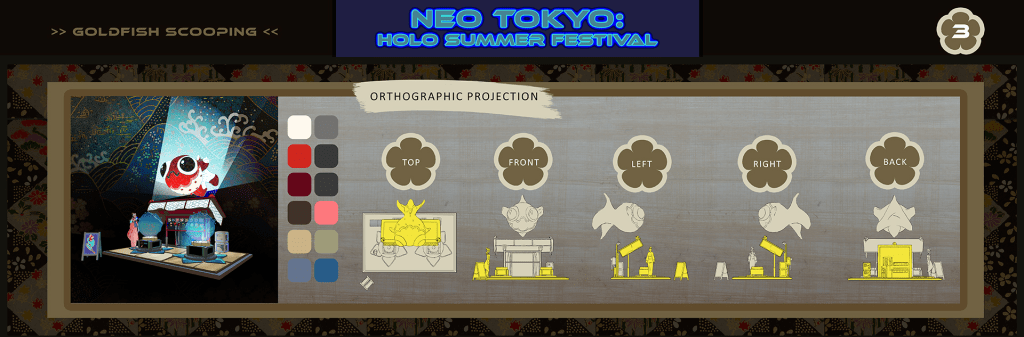
Holo Summer Festival – See more from this project here: https://www.artstation.com/challenges/neo-tokyo/categories/181/submissions/81803
The Fear of Failing
Failing never feels great. We want to succeed. We want to win! Let’s be honest – how many of us truly believe in the famous quote from Ethelbert Talbot (often mistakenly attributed to Pierre de Coubertin, who quoted it himself):
“[…] The important thing is not winning, but taking part.”
Let’s be real honest here, now – we want to win in most cases. It’s a great feeling, even if you’re not a particularly competitive person.
However, I think there is something even more rewarding than winning over someone else: it is feeling validated. Feeling seen. Feeling acknowledged and recognized.
Winning is a state we associate with this feeling because it is one of the first things we learn to appreciate as children. We do something well, we get praised, sometimes even rewarded.
But something that doesn’t happen enough in many cultures – especially when we’re kids – is receiving praise for overcoming obstacles.
When we do something wrong, we are more likely to be scolded for our mistakes. Among peers, especially at a young age, we may even be made fun of for them.
And that makes us perceive, in time, failure as wrong. As something to be ashamed of.
The Role of Failure in Learning
But making mistakes is how we learn as babies.
We try. We fail. We try something different. We find the right way to do it.
If you think about it, the same concept applies to most video games. No one is there to witness how many times we fail before obtaining a legendary weapon, so we accept it. Or how long it takes us to guide Mario from the start to the end of a level.
Science itself is built on failure.
“I haven’t failed, I’ve found 10,000 ways that don’t work.” — Thomas Edison
Many years later, Steve Jobs (less science, more business) expressed a similar idea:
“To get to the right design, you have to go through a lot of bad ideas.”
What does this mean? Our first attempt is rarely our best. Sometimes it is, potentially. But even if our first idea is the best one, refining it through iterations is what makes it truly great. And to get through those iteration we need to embrace constructive feedback, even if it points out that we took a wrong turn on our design and we need to change it or even start back.
We only really fail if we refuse to learn from the process and we stop ourselves from going were we and our art are meant to be.
Iteration, Refinement, and the Right Idea
When we first conceive an idea, we often pull it from the most accessible layer of our consciousness – where common tropes and familiar ideas live. That’s not necessarily a bad thing! Sometimes we need tried-and-tested ideas. It depends on the task.
Maybe we have a deadline, and we don’t have time or the mental space to dig deeper. In that case, choosing a simple, effective idea can be the right decision.
But if you want to create something special – something tailored to a project, a theme, or an audience – you need to go deeper. You need to find what ticks all the boxes while also carrying a part of you in it (especially in an artistic field). And that requires accepting iterations, feedback, and failure – cycling through these until your idea is ripe and ready to be released into the world.
Going back to science, Albert Einstein said:
“A person who never made a mistake never tried anything new.”
This applies to things that are completely new to us. But not everything has to be unknown to still be a challenge. Sometimes, stepping out of our comfort zone is enough.
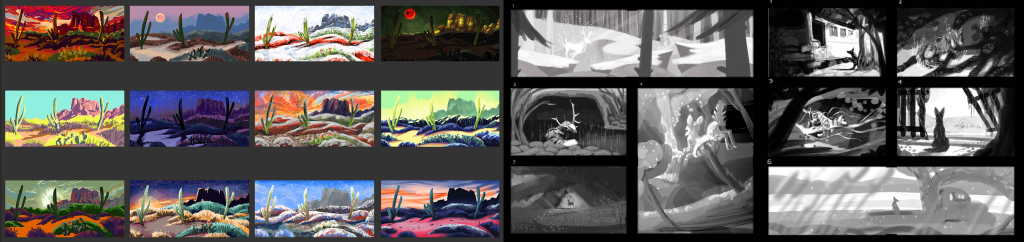
On the right that was the first time I actually decided to integrate iteration of thumbnails into my workflow and it was for an art test. It wasn’t only something that gave me the possibility to choose the best frame to progress with. While doing it I unlocked a lot of ideas for that world I was working on and it became vivid and full of life, which allowed me to expand the richness and details of my test even further.
The “What If” Trap
We often hesitate to try new things, even when they seem like the best path forward.
- “What if it takes me too much time?”
- “What if I’m just not good at doing things that way?”
There are so many “What ifs…”
I mean, Marvel created an entire series based on this concept! But we often ignore the other side of the “What if” coin:
- “What if I don’t reach the result I need because my current process doesn’t allow it?”
- “What if I avoid what I need to do until it’s too late to go back and fix it?”
A new process, situation, or train of thought can be a struggle – for some of us more than others. But if deep down, you know it’s the best path forward, trust it. More importantly, trust that stepping into the unknown is the wisest choice if it feels right.
Choosing the Right Kind of Failure
Are you afraid of failing? Ask yourself this:
Would you rather fail because you refused to follow the best course of action, or fail while trying something new, pushing yourself, and rising to the challenge?
Sometimes, failure is unavoidable. The best kind of failure however is the one that teaches you something new – even if it’s simply understanding what didn’t work and what to try next.

So I asked my mentor advices on how make my initial ideas more impactful. Going back and forth through this process helped me scrap a lot of iterations less successful, learning new valuable things about fighting scenes composition and – in the end – gave me a piece I am happy with!
A Practical Example
Imagine you’re hired at an animation studio. You have a good eye for color but don’t fully understand how values and lighting work, yet.
When you paint, you rely partly on instinct and partly on references. But without knowing the fundamentals, applying a reference to a completely different picture can be challenging.
Now, one day, you’re asked to take an image and create five different lighting or emotional color variations. Specific ones. No improvisation.
But you don’t know how.
You have two choices:
- Spend all your time trying to reach the result using your current method. Maybe you’ll get it right for some of the paintings in front of you, but a single one might completely throw you off, leading to endless revisions and frustration.
- Spend some time researching first. Open Google, ask other artists, find a tutorial. Yes, you don’t have much time to practice. Yes, this time the result might not be perfect. But you’ll get there. It’s a first step.
And if you keep practicing, next time, you’ll have a process – one that allows you to confidently create any lighting or mood, rather than relying purely on instinct.
Your work will no longer be based on just a feeling. It will be created on the solid base of a structured method, enriched by your unique artistic touch.
The Real Failure to Fear
I’ll close with a quote from Marie Curie:
“One never notices what has been done; one can only see what remains to be done.”
This touch another kind of failure – the only one, in my opinion, that we should truly fear:
To become so used to what we already know that we stop appreciating our progress.
To only see what is ahead and feel overwhelmed, as if we’ll never be able to reach it.
But you will. You’ve done so much already.
You’ve grown in art. You’ve grown in every other aspect of your life. Since the moment you were born, you kept learning and shaping yourself into who you are today: a person unique, unlike any other. Because, even if we are all similar, we all grow up navigating through a million different choices combinations.
And that is why, at any time, you are irreplaceable. Because there is only one you, only one person shaped exactly as you are.
As human beings, we are all similar. So our differences shine through and makes us special.
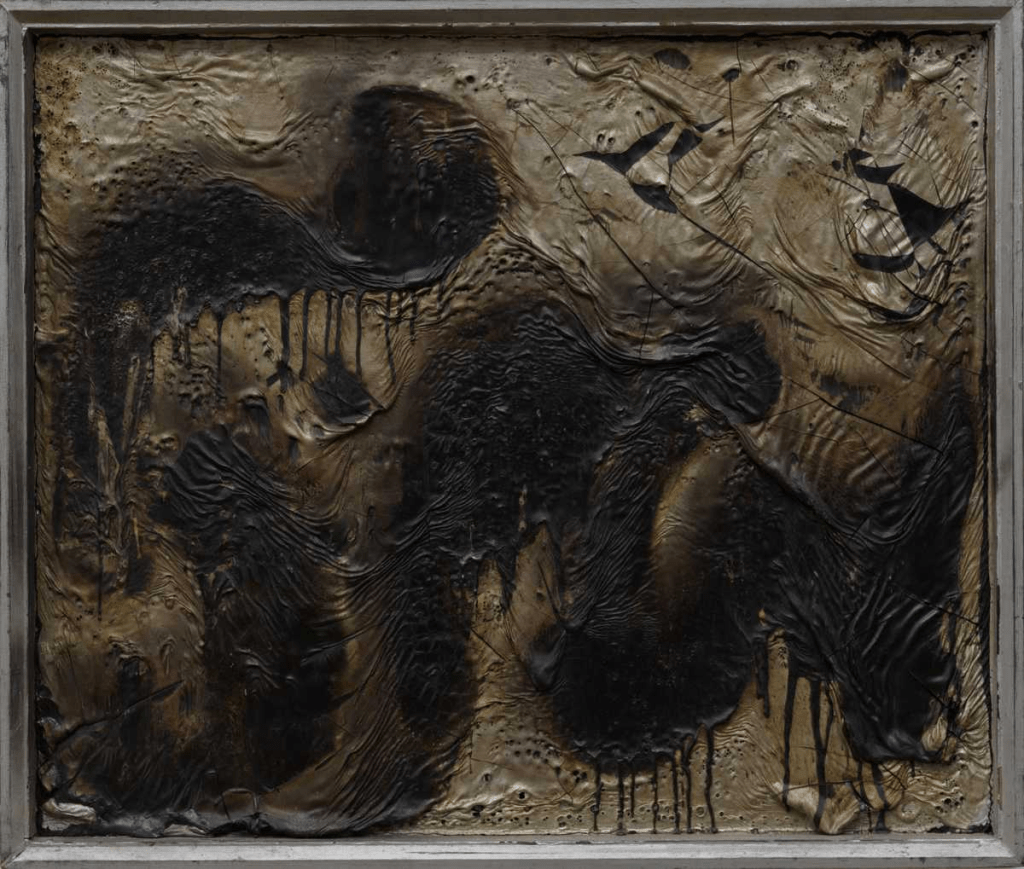
Defeat (1963)
If this topic is talking to you I would recommend you to also listen to this episode presented on the Tate website with the title “The Art of Failure” https://www.tate.org.uk/art/artists/lubaina-himid-cbe-ra-2356/art-failure where artists, a poet, a novelist and a dancer reflect on their experience of art and failure.
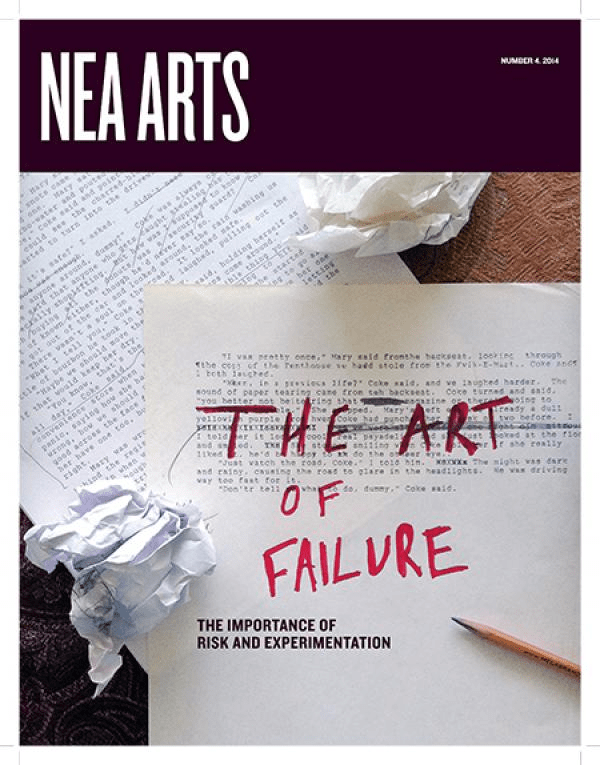
Failure is not the enemy – it is part of the journey. It teaches us, challenges us, and pushes us beyond our comfort zones. From science to art, from childhood to professional life, every meaningful skill we develop is shaped by trial and error. Avoiding failure means avoiding growth, but embracing it means discovering new possibilities, refining our ideas, and ultimately becoming better at what we do.
So, the next time fear of failure creeps in, remember: failing while trying is always better than failing by standing still. Each mistake carries a lesson, each challenge builds resilience, and each step – successful or not – brings you closer to the person and artist you are meant to be.
✏️ Elisa Moriconi – that’s my name! – is a concept artist and illustrator who’s intent is to help artists navigate creative careers. That’s why I created this blog. Learn more at bethatartist.com
 Be That Artist
Leave a comment